BDNF ELISA Kit
 (12 Referenzen)
 (1 Validierung)
Kurzübersicht für BDNF ELISA Kit (ABIN411259)
Target
Alle BDNF ELISA Kits anzeigenBindungsspezifität
Reaktivität
Nachweismethode
Methodentyp
Detektionsbereich
Applikation
Proben
-
-
Untere Nachweisgrenze
- 31.2 pg/mL
-
Verwendungszweck
- Sandwich Mouse BDNF ELISA Kit to quantitate Mouse Bdnf in cell culture supernatants, cell lysates, serum and plasma (heparin, EDTA, citrate).
-
Analytische Methode
- Quantitative
-
Spezifität
-
Expression system for standard: NS0
Immunogen sequence: H129-R247Capture antibody and Detection antibody: monoclonal antibody from mouse, monoclonal antibody from mouse
-
Kreuzreaktivität (Details)
- There is no detectable cross-reactivity with other relevant proteins.
-
Sensitivität
- < 15 pg/mL
-
Bestandteile
-
- Pre-coated 96-well strip microplate
- Standard
- Biotinylated antibody (100x)
- Avidin-Biotin-Peroxidase Complex (100x)
- Sample Diluent
- Antibody Diluent
- Avidin-Biotin-Peroxidase Diluent
- Color Developing Reagent (TMB)
- Stop Solution
- Wash Buffer (25x)
- Adhesive plate sealers
-
Benötigtes Material
- Microplate Reader capable of reading absorbance at 450nm. Incubator. Automated plate washer (optional). Pipettes and pipette tips capable of precisely dispensing 0.5 μL through 1 mL volumes of aqueous solutions. Multichannel pipettes are recommended for large amount of samples. Deionized or distilled water. 500 mL graduated cylinders. Test tubes for dilution.
-
-
Brain-Derived Neurotrophic Factor (BDNF) ELISA Kit
BDNF Reaktivität: Human Colorimetric Sandwich ELISA 31.2 pg/mL - 2000 pg/mL Cell Culture Supernatant, Cell Lysate, Plasma, Serum, Tissue Homogenate
Brain-Derived Neurotrophic Factor (BDNF) ELISA KitBDNF Reaktivität: Ratte AA 129-247 Colorimetric Sandwich ELISA 31.2 pg/mL - 2000 pg/mL Cell Culture Supernatant, Cell Lysate, Plasma (EDTA), Plasma (citrate), Plasma (heparin), Serum
Brain-Derived Neurotrophic Factor (BDNF) ELISA KitBDNF Reaktivität: Human AA 129-247 Colorimetric Sandwich ELISA 31.2 pg/mL - 2000 pg/mL Cell Culture Supernatant, Cell Lysate, Plasma (EDTA), Plasma (citrate), Plasma (heparin), Serum
Brain-Derived Neurotrophic Factor (BDNF) ELISA KitBDNF Reaktivität: Human, Maus, Ratte, Kaninchen, Pferd, Ziege Colorimetric Sandwich ELISA 0.156 ng/mL - 10 ng/mL Cell Culture Supernatant, Cell Lysate, Plasma, Serum, Tissue Homogenate
Brain-Derived Neurotrophic Factor (BDNF) ELISA KitBDNF Reaktivität: Meerschweinchen Colorimetric Sandwich ELISA 0.15 ng/mL - 10 ng/mL Cell Culture Supernatant, Cell Lysate, Plasma, Serum, Tissue Homogenate
Brain-Derived Neurotrophic Factor (BDNF) ELISA KitBDNF Reaktivität: Kaninchen Colorimetric Sandwich ELISA 31.2 pg/mL - 2000 pg/mL Cell Culture Supernatant, Cell Lysate, Plasma, Serum, Tissue Homogenate
Brain-Derived Neurotrophic Factor (BDNF) ELISA KitBDNF Reaktivität: Maus Colorimetric Sandwich ELISA 0.312 ng/mL - 20 ng/mL Cell Culture Supernatant, Cell Lysate, Plasma, Serum, Tissue Homogenate
Brain-Derived Neurotrophic Factor (BDNF) ELISA KitBDNF Reaktivität: Ratte Colorimetric Sandwich ELISA 7.8 pg/mL - 500 pg/mL Cell Culture Supernatant, Cell Lysate, Plasma, Serum, Tissue Homogenate
Brain-Derived Neurotrophic Factor (BDNF) ELISA KitBDNF Reaktivität: Ratte Colorimetric Sandwich ELISA 31.25 pg/mL - 2000 pg/mL Cell Culture Supernatant, Plasma, Serum
Brain-Derived Neurotrophic Factor (BDNF) ELISA KitBDNF Reaktivität: Affe Colorimetric Sandwich ELISA 0.78 ng/mL - 50 ng/mL Plasma, Serum, Tissue Homogenate
-
-
Applikationshinweise
- Before using Kit, spin tubes and bring down all components to bottom of tube. Duplicate well assay was recommended for both standard and sample testing.
-
Probenmenge
- 100 μL
-
Plattentyp
- Pre-coated
-
Protokoll
- ELISA Kit is based on standard sandwich enzyme-linked immune-sorbent assay technology. An antibody has been precoated onto 96-well plates. Standards and test samples are added to the wells, a biotinylated detection antibody specific for target is added subsequently and then followed by washing with PBS or TBS buffer. Avidin-Biotin-Peroxidase Complex was added and unbound conjugates were washed away with PBS or TBS buffer. HRP substrate TMB was used to visualize HRP enzymatic reaction. TMB was catalyzed by HRP to produce a blue color product that changed into yellow after adding acidic stop solution. The density of yellow is proportional to the target amount in sample captured in plate.
-
Testpräzision
-
Intra-Assay Precision (CV%): 7%, 7.4%, 5%
Inter-Assay Precision (CV%): 8.9%, 9.2%, 6.6% -
Beschränkungen
- Nur für Forschungszwecke einsetzbar
-
-
- by
- Prof. Merighi, Laboratory of Neurobiology, Department of Veterinary Sciences, University of Turin
- No.
- #103751
- Datum
- 18.04.2019
- Antigen
- BDNF
- Chargennummer
- 3814117212
- Validierte Anwendung
- ELISA
- Positivkontrolle
Adult mouse spinal cord (2-3 months old). A total of 10 animals (5 zymosan-treated mice and 5 control mice) were used.
- Negativkontrolle
blank control
- Bewertung
Passed. ABIN411259 was used to evaluate the effect of zymosan administration on the level of BDNF in the spinal cord.
- Primärantikörper
- Sekundärantikörper
- Full Protocol
- Inject 20µl of a solution of 3mg/ml of zymosan A (zym) dissolved in PBS subcutaneously under the left hind paw of adult CD1 male mice (2-3 month old). Inject control mice with 20µl of PBS only.
- Anesthetize mice with an intraperitoneal injection of pentothal and sacrifice. Dissect out lumbar spinal cord segments L1–L6 separating the dorsal left segment from the dorsal right one.
- Freeze samples rapidly in liquid nitrogen and then store at -80°C.
- Homogenize samples in 100µl lysis buffer (150mM KCl, 20mM HEPES, 5mM MgCl2, 0.5mM DTT 0.5).
- Clarify lysates by centrifugation (2min, 10000g, 4°C) and determine protein concentration of the supernatant using Bradford assay (Sigma-Aldrich).
- Perform ELISA assay according to the kit protocol.
- Use two replicates for each standard and sample.
- Standard: prepare a total of 8 tubes. Add 200μl of the 10ng/ml standard stock solution into 800μl of sample diluent buffer in the first tube. Add 300μl of sample diluent buffer to tubes 2-7. Add 300μl of the standard solution from tube 1 to the second tube for a final volume of 600μl and mix. Repeat the operation for tubes 3 to 7.
- Add 100μl sample diluent buffer as blank standard into the control well and 100μl of diluted standards into the standard wells (31.25pg/ml, 62.5pg/ml, 125pg/ml, 250pg/ml, 500pg/ml, 1000pg/ml, 2000pg/ml).
- For test sample wells, add 90μl of sample diluent buffer and 10μl of sample without touching the side of the well.
- Cover the plate with plate sealer and incubate at 37°C for 90min.
- Discard the liquid by clapping the plate on an absorbent filter.
- Add 100μl of 1x biotinylated anti-mouse BDNF antibody into each well.
- Cover the plate with plate sealer and incubate at 37°C for 60min.
- Wash the plate by clapping the plate on an absorbent filter paper and filling each well with Wash Buffer. Leave the plate on a shaker for 1 minutes. Repeat for a total of four washes.
- Add 100μl of 1x Avidin-Biotin-Peroxidase Complex into each well.
- Cover the plate with plate sealer and incubate at 37°C for 30min.
- Remove plate sealer and washed the plate 5x as indicated above.
- Add 90μl of Color Developing Reagent into each well and incubate in the dark 25min at 37°C.
- Add 100μl of Stop solution into each well and we read the O.D. absorbance at 450nm immediately after in a microplate reader.
- Anmerkungen
Validierung #103751 (ELISA)
 Validierungsbilder
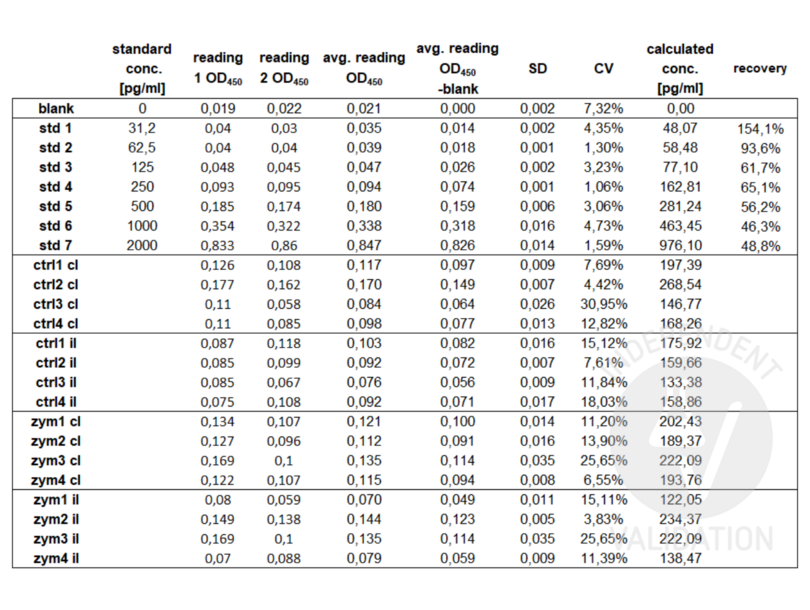
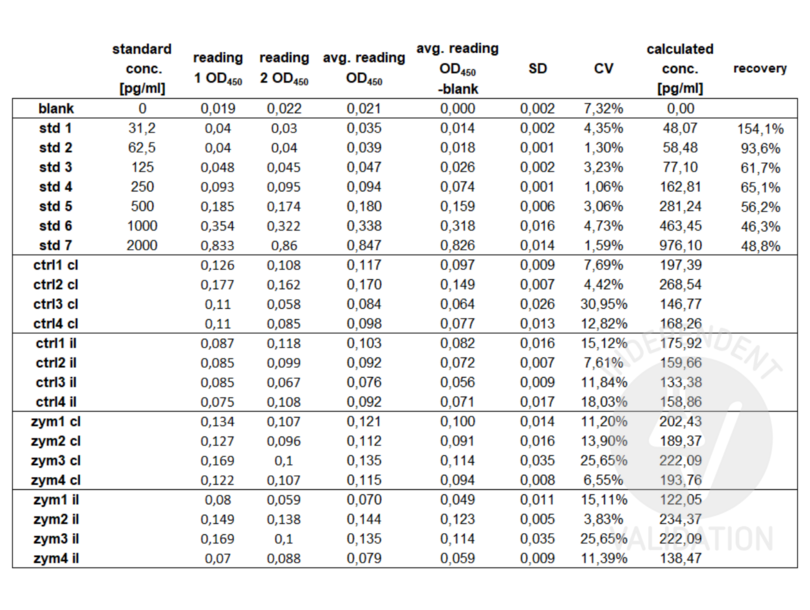
![OD450 raw values and calculated BDNF concentrations (std = standard samples; ctrl= control mice; zym = zymosan injected mice; il = dorsal horn ipsilateral to the injected paw; cl = dorsal horn contralateral to the injected paw).]() OD450 raw values and calculated BDNF concentrations (std = standard samples; ctrl= control mice; zym = zymosan injected mice; il = dorsal horn ipsilateral to the injected paw; cl = dorsal horn contralateral to the injected paw).
OD450 raw values and calculated BDNF concentrations (std = standard samples; ctrl= control mice; zym = zymosan injected mice; il = dorsal horn ipsilateral to the injected paw; cl = dorsal horn contralateral to the injected paw).
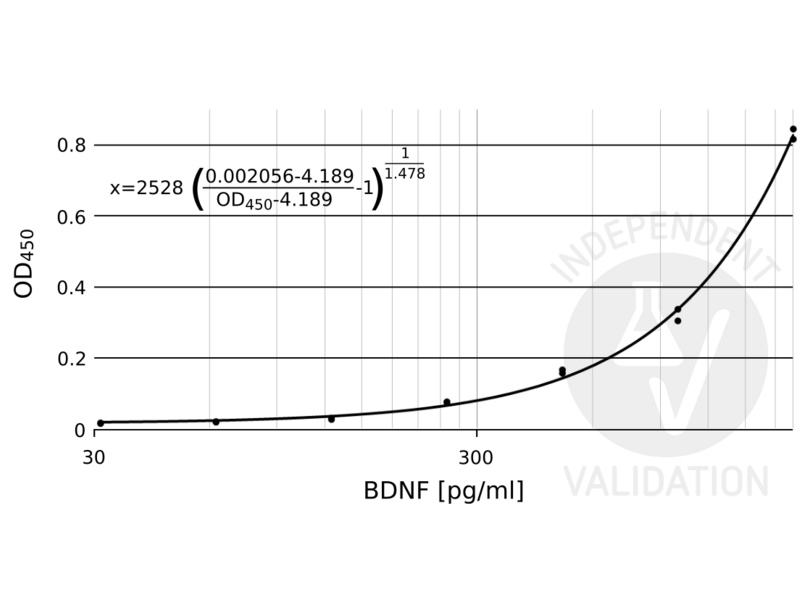
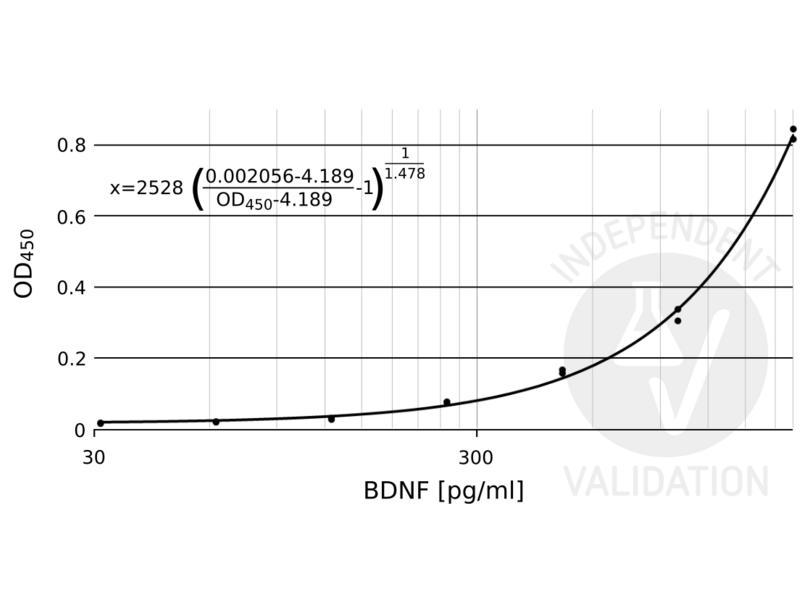
![ABIN411259 standard curve]() ABIN411259 standard curve
ABIN411259 standard curve
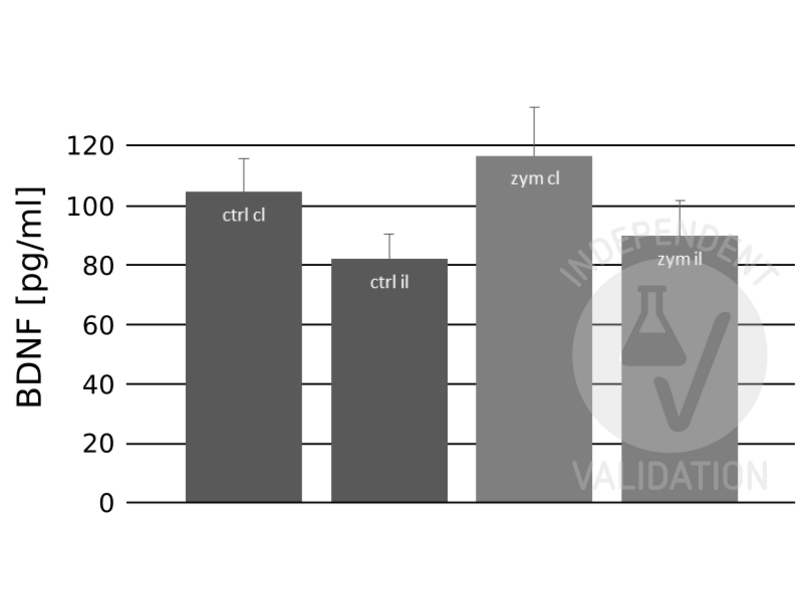
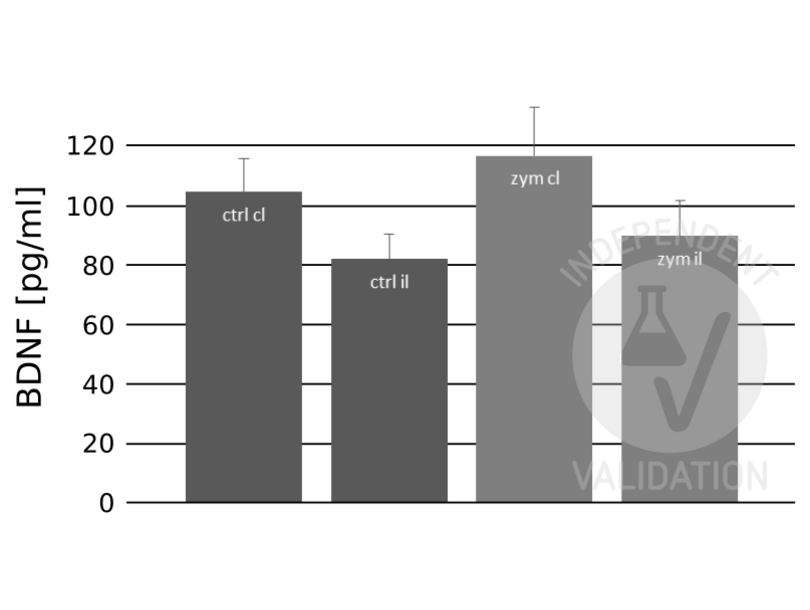
![Average BDNF concentrations obtained after the normalization with total protein concentration. Abbreviations: ctrl = control; zym= zymosan injected mice, cl = contralateral; il = ipsilateral]() Average BDNF concentrations obtained after the normalization with total protein concentration. Abbreviations: ctrl = control; zym= zymosan injected mice, cl = contralateral; il = ipsilateral
Protokoll
Average BDNF concentrations obtained after the normalization with total protein concentration. Abbreviations: ctrl = control; zym= zymosan injected mice, cl = contralateral; il = ipsilateral
Protokoll -
-
Handhabung
- Avoid multiple freeze-thaw cycles.
-
Lagerung
- -20 °C,4 °C
-
Informationen zur Lagerung
- Store at 4°C for 6 months, at -20°C for 12 months. Avoid multiple freeze-thaw cycles (Ships with gel ice, can store for up to 3 days in room temperature. Freeze upon receiving.)
-
Haltbarkeit
- 12 months
-
-
-
: "The behavioral and physiological effects of high-fat diet and alcohol consumption: Sex differences in C57BL6/J mice." in: Brain and behavior, Vol. 7, Issue 6, pp. e00708, (2018) (PubMed).
: "Lentivirus-mediated interleukin-1β (IL-1β) knock-down in the hippocampus alleviates lipopolysaccharide (LPS)-induced memory deficits and anxiety- and depression-like behaviors in mice." in: Journal of neuroinflammation, Vol. 14, Issue 1, pp. 190, (2018) (PubMed).
: "Spirulina maxima Extract Ameliorates Learning and Memory Impairments via Inhibiting GSK-3β Phosphorylation Induced by Intracerebroventricular Injection of Amyloid-β 1-42 in Mice." in: International journal of molecular sciences, Vol. 18, Issue 11, (2018) (PubMed).
: "Ondansetron ameliorates depression associated with obesity in high-fat diet fed experimental mice: An investigation-based on the behavioral, biochemical, and molecular approach." in: Indian journal of pharmacology, Vol. 49, Issue 4, pp. 290-296, (2018) (PubMed).
: "Chronic Hippocampal Abnormalities and Blunted HPA Axis in an Animal Model of Repeated Unpredictable Stress." in: Frontiers in behavioral neuroscience, Vol. 12, pp. 150, (2018) (PubMed).
: "Modulation of nuclear REST by alternative splicing: a potential therapeutic target for Huntington's disease." in: Journal of cellular and molecular medicine, (2017) (PubMed).
: "Resveratrol reversed chronic restraint stress-induced impaired cognitive function in rats." in: Molecular medicine reports, Vol. 16, Issue 2, pp. 2095-2100, (2017) (PubMed).
: "Differential Efficacy of Ketamine in the Acute versus Chronic Stages of Complex Regional Pain Syndrome in Mice." in: Anesthesiology, Vol. 123, Issue 6, pp. 1435-47, (2016) (PubMed).
: "Fingolimod induces neurogenesis in adult mouse hippocampus and improves contextual fear memory." in: Translational psychiatry, Vol. 5, pp. e685, (2016) (PubMed).
: "Granulocyte colony-stimulating factor promotes behavioral recovery in a mouse model of traumatic brain injury." in: Journal of neuroscience research, Vol. 94, Issue 5, pp. 409-23, (2016) (PubMed).
: "The effects of EGb761 on lipopolysaccharide-induced depressive-like behaviour in C57BL/6J mice." in: Central-European journal of immunology / Polish Society for Immunology and eleven other Central-European immunological societies, Vol. 40, Issue 1, pp. 11-7, (2015) (PubMed).
: "Brain neuroplastic changes accompany anxiety and memory deficits in a model of complex regional pain syndrome." in: Anesthesiology, Vol. 121, Issue 4, pp. 852-65, (2014) (PubMed).
-
-
- BDNF (Brain-Derived Neurotrophic Factor (BDNF))
-
Andere Bezeichnung
- BDNF
-
Hintergrund
-
Background: Brain-derived neurotrophic factor (BDNF) is a prosurvival factor induced by cortical neurons that is necessary for survival of striatal neurons in the brain. It is a secreted protein with the molecular weight of 27.8 kDa, consisting of 247 amino acids. It is known to promote neuronal survival and differentiation. BDNF shares substantial amino acid sequence identity with nerve growth factor (NGF). BDNF and neurotrophin-3 (NT-3) are two recently cloned neurotrophic factors that are homologous to NGF. mRNA products of the BDNF and NT-3 genes are detected in the adult human brain, suggesting that these proteins are involved in the maintenance of the adult nervous system. BDNF and other neurotrophins are critically involved in long-term potentiation (LTP). BDNF-mediated LTP is induced postsynaptically. BDNF has trophic effects on serotonergic (5-HT) neurons in the central nervous system. BDNF has an essential maintenance function in the regulation of anxiety-related behavior and in food intake through central mediators in both the basal and fasted state. It plays a role in treating breathing disorders such as respiratory insufficiency after spinal injury. The mature form of BDNF is identical in all mammals examined, and the gene encoding human BDNF to chromosome 11, band p13.
Gene Full Name: brain derived neurotrophic factor
-
Gen-ID
- 12064
-
UniProt
- P21237
-
Pathways
- RTK Signalweg, Synaptic Membrane, Feeding Behaviour, Dicarboxylic Acid Transport, Regulation of long-term Neuronal Synaptic Plasticity
Target Alle BDNF ELISA Kits anzeigen
-