BDNF Antikörper (AA 20-252)
 (1 Validierung)
Kurzübersicht für BDNF Antikörper (AA 20-252) (ABIN7445432)
Target
Alle BDNF Antikörper anzeigenReaktivität
Wirt
Klonalität
Konjugat
Applikation
-
-
Bindungsspezifität
- AA 20-252
-
Verwendungszweck
- Polyclonal Antibody to Brain Derived Neurotrophic Factor (BDNF)
-
Spezifität
- The antibody is a rabbit polyclonal antibody raised against BDNF. It has been selected for its ability to recognize BDNF in immunohistochemical staining and western blotting.
-
Kreuzreaktivität
- Ziege, Pferd, Human, Maus, Schwein, Kaninchen, Ratte
-
Aufreinigung
- Antigen-specific affinity chromatography followed by Protein A affinity chromatography
-
Immunogen
- Recombinant Brain Derived Neurotrophic Factor (BDNF) corresdonding to Pro20~Arg252 with N-terminal His Tag
-
Isotyp
- IgG
-
-
anti-Brain-Derived Neurotrophic Factor (BDNF) (AA 19-248) antibody
BDNF Reaktivität: Human WB, ELISA, ICC Wirt: Maus Monoclonal 3D9C5 unconjugated
anti-Brain-Derived Neurotrophic Factor (BDNF) (AA 20-252) antibodyBDNF Reaktivität: Schwein IHC, ICC, IF Wirt: Kaninchen Polyclonal unconjugated
anti-Brain-Derived Neurotrophic Factor (BDNF) (AA 206-236), (C-Term) antibodyBDNF Reaktivität: Human WB, IF, FACS, IHC (p) Wirt: Kaninchen Polyclonal RB14839 unconjugated
anti-Brain-Derived Neurotrophic Factor (BDNF) (AA 20-252) antibodyBDNF Reaktivität: Schwein WB, IHC Wirt: Maus Monoclonal C2 unconjugated
anti-Brain-Derived Neurotrophic Factor (BDNF) (AA 1-247) antibodyBDNF Reaktivität: Human WB, ELISA, IP, IF Wirt: Maus Monoclonal 1B10 unconjugated
anti-Brain-Derived Neurotrophic Factor (BDNF) (AA 151-247) antibodyBDNF Reaktivität: Human WB, IF (cc), IF (p), FACS, IHC (p), IHC (fro) Wirt: Kaninchen Polyclonal unconjugated
anti-Brain-Derived Neurotrophic Factor (BDNF) (Internal Region) antibodyVerified BDNF Reaktivität: Human ELISA, IF Wirt: Ziege Polyclonal unconjugated
anti-Brain-Derived Neurotrophic Factor (BDNF) (AA 129-247) antibodyBDNF Reaktivität: Human, Ratte, Maus WB, IHC (p) Wirt: Kaninchen Polyclonal unconjugated
anti-Brain-Derived Neurotrophic Factor (BDNF) (AA 129-247) antibodyBDNF Reaktivität: Human, Ratte, Maus WB, IHC Wirt: Kaninchen Polyclonal unconjugated
anti-Brain-Derived Neurotrophic Factor (BDNF) (AA 206-236) antibodyBDNF Reaktivität: Human WB, ELISA, IF, FACS Wirt: Kaninchen Polyclonal unconjugated
-
-
Applikationshinweise
- Western blotting: 0.01-2 μg/mLImmunohistochemistry: 5-20 μg/mLImmunocytochemistry: 5-20 μg/mLOptimal working dilutions must be determined by end user.
-
Kommentare
-
The thermal stability is described by the loss rate. The loss rate was determined by accelerated thermal degradation test, that is, incubate the protein at 37°C for 48h, and no obvious degradation and precipitation were observed. The loss rate is less than 5% within the expiration date under appropriate storage condition.
-
Beschränkungen
- Nur für Forschungszwecke einsetzbar
-
-
- by
- Prof. Merighi, Laboratory of Neurobiology, Department of Veterinary Sciences, University of Turin
- No.
- #104644
- Datum
- 15.11.2026
- Antigen
- BDNF (Brain-Derived Neurotrophic Factor (BDNF))
- Chargennummer
- A20260304024
- Validierte Anwendung
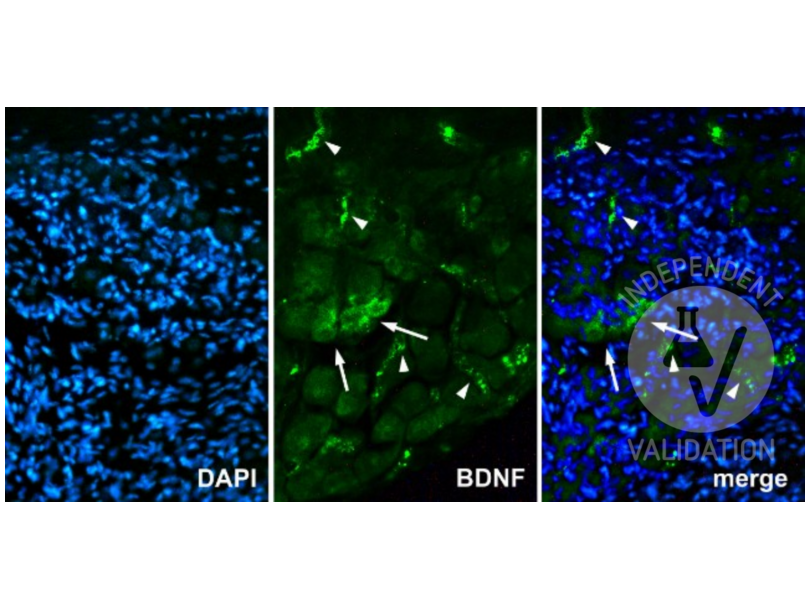
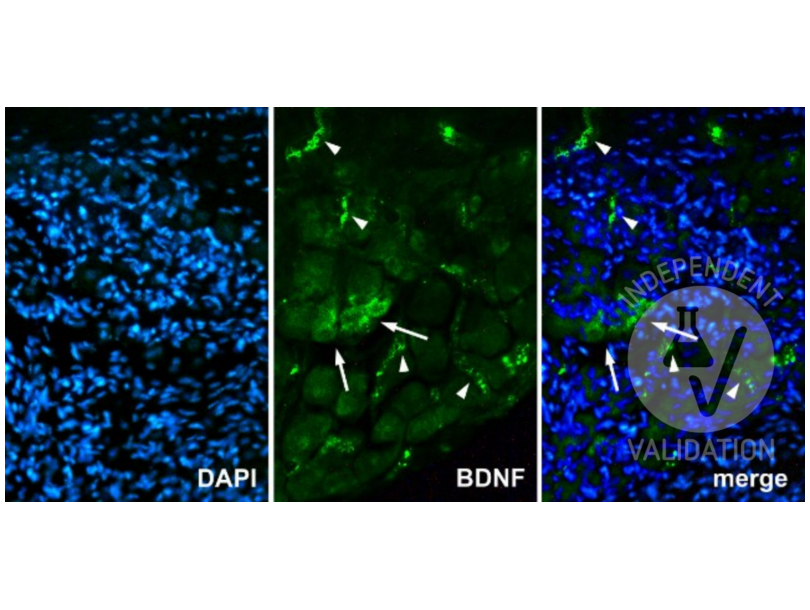
- Immunohistochemistry
- Positivkontrolle
Sections from the same tissues were incubated with an anti-digoxigenin antibody conjugated with alkaline phosphatase (AP) and developed with NBT/BCIP solution.
- Negativkontrolle
Omission of primary antibody ABIN7445432
- Bewertung
The antibody works in IHC (fro) at concentrations from 1:25-1:100. Background staining may be high.
- Primärantikörper
- ABIN7445432
- Sekundärantikörper
- anti-rabbit Alexa Fluor 488 (Invitrogen A11008, lot # 3112790)
- Full Protocol
- Sample analyzed: dorsal root ganglion (DRG) of adult Tafa4 heterozygous knock-in mice on a C57BL/6 background.
- Samples were fixed in paraformaldehyde and cryoprotected with a 30% sucrose solution in 0.01 M PBS, then frozen with OCT compound.
- Frozen slices (20 µm thick) were washed 3 × 5 minutes in 0.01 M PBS.
- Sections were blocked in 1% ovalbumin for 1 hour at room temperature.
- 3 × 5-minute washes in 0.01 M PBS.
- Sections were incubated with the primary antibody at dilutions of 1:25, 1:50, and 1:100 overnight at room temperature (the primary antibody was diluted in PLL/BSA/PBS diluent).
- 3 × 5-minute washes in 0.01 M PBS.
- Incubation with the anti-rabbit secondary antibody at 1:400 in PLL/BSA/PBS diluent for 1 hour at room temperature.
- 3 × 5-minute washes in 0.01 M PBS.
- Nuclear counterstaining was performed with 1 µg/mL 4′,6-diamidino-2-phenylindole dihydrochloride (DAPI) for 2 minutes.
- 2 × 5-minute washes in 0.01 M PBS.
- Specimens were then mounted in Fluoroshield mounting medium (Sigma).
- Images were acquired with a Leica DM 6000B fluorescence microscope equipped with a digital camera at 63× magnification.
- Anmerkungen
To exclude any nonspecific signal due to the secondary antibody, one control slice was processed for each experimental procedure, omitting the primary antibody.
Validierung #104644 (Immunohistochemistry)
 Validierungsbilder
![Immunostaining of mouse DRG neurons with ABIN7445432. Staining is evident in the cell bodies of some small-diameter neurons (arrows) and in axonal profiles (arrowheads).]() Immunostaining of mouse DRG neurons with ABIN7445432. Staining is evident in the cell bodies of some small-diameter neurons (arrows) and in axonal profiles (arrowheads).
Protokoll
-
-
Format
- Liquid
-
Konzentration
- 0.5 mg/mL
-
Buffer
- PBS, pH 7.4, containing 0.02 % Sodium azide, 50 % glycerol.
-
Konservierungsmittel
- Sodium azide
-
Vorsichtsmaßnahmen
- This product contains Sodium azide: a POISONOUS AND HAZARDOUS SUBSTANCE which should be handled by trained staff only.
-
Lagerung
- 4 °C,-20 °C
-
Informationen zur Lagerung
- Store at 4°C for frequent use. Stored at -20°C in a manual defrost freezer for two year without detectable loss of activity. Avoid repeated freeze-thaw cycles.
-
Haltbarkeit
- 24 months
-
-
- BDNF (Brain-Derived Neurotrophic Factor (BDNF))
-
Andere Bezeichnung
- BDNF
-
Hintergrund
- Neurotrophin, Abrineurin
-
Pathways
- RTK Signalweg, Synaptic Membrane, Feeding Behaviour, Dicarboxylic Acid Transport, Regulation of long-term Neuronal Synaptic Plasticity
Target
-